Post 8: Bubbles, Escher, Back
(London, Rome, Bombay)

GEB or Gödel, Escher, Bach (pub. 1979) by Douglas Hofstadter is (thankfully) one of just a handful of books that I have started reading, but haven't completed, so … why pick this particular book to write about? Three reasons: 1. it’s an utterly fascinating book, 2. (more importantly) it’s related to the last post, and 3. I have gotten through about 2/3rds of it, which I claim gives me at least 1/2 a leg to stand on.
The book has been sitting snugly on my bookshelf for many years between two other books that I have also not read to completion … coincidentally, both written by Nobel laureates: The Age Of Insight, a book set in 1900s Vienna about art and the unconscious mind, and a book about good economics in bad times that I only have because I went to a Banerjee/Duflo book-signing once. I would never, ever buy a book on economics otherwise, and I have the bank balance to prove it.
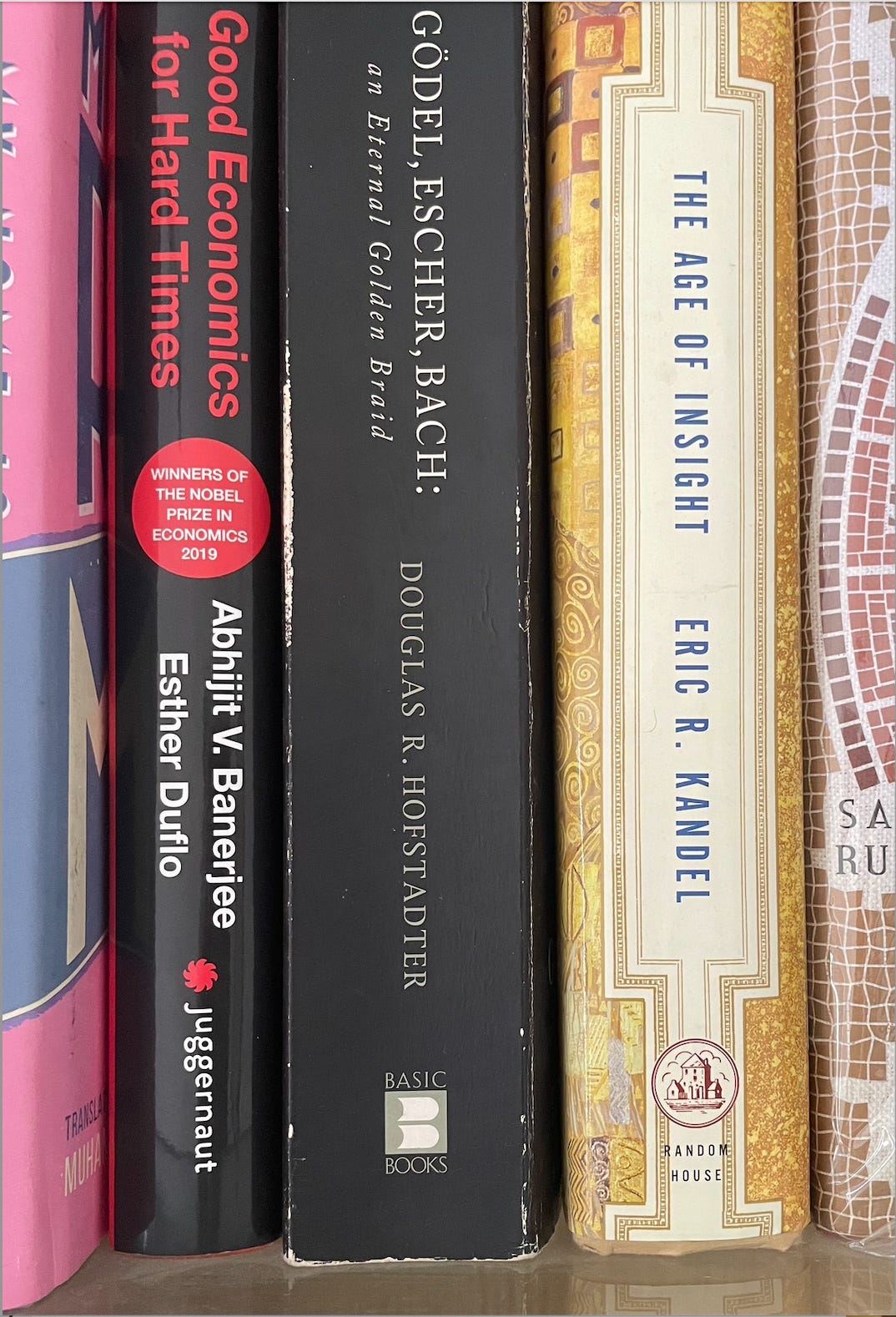
Hofstadter uses three tropes … the incompleteness theorems of Kurt Gödel (1906-1978), the paradoxical art of MC Escher (1898-1972), and the recursive music of Johann Sebastian Bach (1685-1750) to put forth the idea that human intelligence, creativity, and consciousness all arise from self-referencing, recursive loops in our brains … loops which he aptly calls ‘strange loops’. He then goes on to show how these strange loops can create meaning in our brains, even when the building blocks themselves (e.g. neurons) have none.
“When and only when such a loop arises in a brain or in any other substrate, is a person — a unique new ‘I’ — brought into being. Moreover, the more self-referentially rich such a loop is, the more conscious is the self to which it gives rise.”
‘Something out of Nothing’ generally speaking, is not a very popular idea, but I ask, how else can it be? If something always has to come from something else, then where does the ‘something from something’ cascade end? (Reductio ad absurdum!)
Back to the book: we all know something about Bach’s music, and MC Escher features later in this post, so it behooves me to write a few words here about Kurt Gödel: Gödel was a philosopher and a mathematician. He was also a colleague of Einstein’s at Princeton, and his incompleteness theorems quite literally pulled the rug from under the feet of mathematicians and all their math (now there’s a visual!) when he proved that all formal systems (even mathematical ones) always contain true statements that can’t be proven within the rules of that system - stop for a moment to think about how wonderfully counterintuitive and paradoxical that is! As Hofstadter tells it in GEB:
‘The paraphrase of Gödel's Theorem says that for any record player, there are records which it cannot play because they will cause its indirect self-destruction.’
Hofstadter then goes on to show how these types of limitations also exist in our minds, and how these limitations can (and do) limit our understanding of reality – the truth it seems, is more elusive than we can think. (Which may be an excellent reason to stop looking for it.)
There is a LOT more to GEB of course, and someday when I do finish reading the book, maybe I’ll dedicate an entire post to it … but for now, here’s something that’s less recursive but more cursive instead: BEB – Bubbles, Escher, Back!$*!$!
Bubbles |
Bubbles is luxury! Bubbles is life!!
I came to this effervescent realization at a recent (free!) stay at a Taj in London. Of course I’ve had had sparkling water before, I am not that much of a rube, but you see the difference is that in Europe, sparkling water isn’t just an occasional indulgence, it’s a way of life. And I love it!
I am also sure that there’s a scientific explanation as to why the lovely bubbles quench thirst better – especially given that per glass, there has to be lesser water in a glass of sparkling water than a glass of still water, but still for once, I don’t care about the science … life, it turns out isn’t about glass-half-full or glass-half-empty, it’s about glass-full-of-göödles of bööbles … wheee!
‘Therapy is extremely expensive. Popping bubble wrap is radically cheap.’ - Jimmy Buffett
Side note: I am cheap, and so my default mode is to turn down services, but at this same Taj, I also discovered for the first time what a turndown service actually is. I knew of this word (I am not that much of a rube), but I had never really given it a second thought, and honestly if I hadn’t been staying with a friend who is much more accustomed to life’s luxuries, I would’ve (fearfully) turned down the turndown services as well, and well, what a voluminous shame that would’ve been.
Escher |
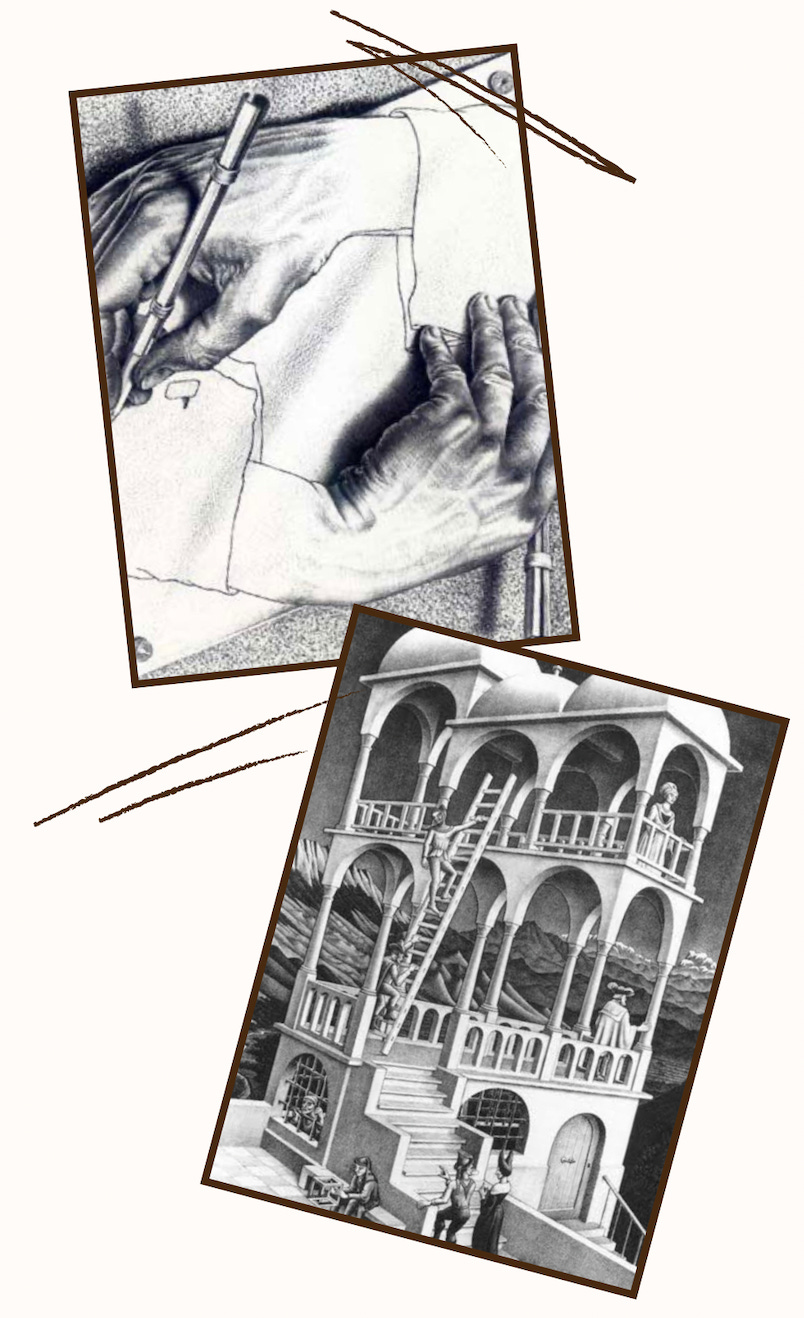
In my minimalist apartment, I remove things with abandon, but add things only after much consideration. I even refrained from buying a magnet on this trip because I think my refrigerator is too crowded … and yet, I returned with a largish poster of an MC Escher exhibit that I very accidentally ran into in Rome. And that’s the thing about Europe – things like this happen all the time. You can just accidentally run into a world-class exhibit, or an insanely beautiful park, or a well-preserved-not-spat-on relic from the past … even when you aren’t looking. It’s almost unfair!
‘Are you sure a floor can’t also be a ceiling?’ – MC Escher
Some of MC Escher’s mind-bending, paradoxical art:
Back |
And now I am back to drinking still water in Mumbai … a very un-still city if I may add. And as much as I miss the bubbly waters of Europe, and the indulgent turndown services, it’s nevertheless nice to be back, because at the end of it all, I am just a boring homebody who likes to spend my days sitting on my gray sofa in my gray study gazing at the gray Arabian Sea … which to my astonishment! had an entirely new addition in the ten days that I was away – suddenly, a rather cute half-loop of a blue bridge had arisen on the horizon. In my jet lag, at first I thought it was an apparition, but found out after some frantic googling that it was in fact a new bridge, and that it went by the refreshingly literal name of ‘the connector’.
In the Indian flag, the orange and the green have come to represent Hindus and Muslims, and increasingly tenuously connecting the two is the blue Ashoka Chakra.
In these months of national elections, may the blue connectors hold steadfastly over still waters.